Tag: Telkom

Padi UMKM

When I first designed what later became Padi UMKM, I did not do it in a boardroom. I did it at home, during long months of WFH in the middle of the Covid-19 pandemic. I drew the system on papers spread on the floor. At that time, my head was full of ideas about ecosystems, complexity theory, and complexity economics. I was not thinking about building another digital platform. I was thinking about how economic coordination itself breaks down under systemic shock, and how new coordination patterns might emerge when old ones collapse. In that sense, Padi UMKM was born less from a product mindset than from an ecosystem mindset, with complexity theory consciously in the background.

When the pandemic hit, what collapsed was not only the economy. What collapsed was the coordination logic of the economy. Supply chains broke, demand evaporated, SMEs lost access to markets, and institutions discovered that their standard operating procedures were designed for stability, not for systemic disruption. Many organisations reacted by accelerating digital projects, launching platforms, and optimising internal processes. That helped, but it did not address the deeper problem. The economic ecosystem itself had lost its organising structure. Actors that were rational in isolation could no longer produce coherent outcomes collectively. This is how complex systems behave under stress: when established coordination patterns fail, local rationality no longer aggregates into systemic order.

Padi UMKM did not start as a brilliant digital product idea. It started as a response to a coordination failure across a fragmented system of SOEs, SMEs, banks, regulators, ministries, and development agencies. All were acting with good intentions, yet through incompatible logics, timelines, and mandates. The system was not short of initiatives; it was short of coherence. In complexity terms, the economy had been pushed far from equilibrium, and the challenge was not optimisation but reorganisation. What was needed was not another tool, but a new pattern of interaction among heterogeneous agents.

The real innovation of Padi UMKM was therefore not the platform. The platform was the easy part. The digital workforce of Telkom Group can design platforms; that is an operational capability. The platform was necessary, and it became the core infrastructure of the ecosystem, but it was not the breakthrough. The breakthrough was the deliberate redefinition of roles within the economic system. SOEs must reposition their procurement operation into a capability of creating new market, i.e. an SME-based market structure. SMEs were not framed as beneficiaries of aid, but as economic agents that could be structurally integrated into formal procurement and value creation. Banks and financial institutions were not treated merely as lenders, but as part of an enabling architecture that combined financing with capability development and pathways to export. What changed was not a feature set. What changed was the pattern of interaction between economic actors.

The formal launching of Padi UMKM itself was not initiated by Telkom or by the Ministry of SOEs. It was planned within the nationwide BBI (Bangga Buatan Indonesia) program, because the central government needed a real, executable instrument to accelerate domestic economic circulation under crisis. Telkom showed a commitment to develop the platform, even though it was still imperfect at that time. The urgency was national, not corporate. This matters, because it positioned Padi UMKM from the beginning not as a corporate product launch, but as a systemic intervention embedded in a national recovery narrative. The early external promotion of Padi UMKM, beyond the internal SOE environment, was also driven by the BBI program. Over time, almost by systemic selection rather than by design, Padi UMKM became the de facto e-commerce infrastructure for BBI, as other platforms could not fit the specific institutional and ecosystemic roles required by the program.

From the beginning, we made a counterintuitive choice in the way the system was governed. Telkom deliberately limited its role to being the product and platform owner. The ecosystem itself was not branded as Telkom’s program. The community was symbolically owned by the Ministry of SOEs and by SOEs collectively. Even the name Padi UMKM did not originate from Telkom. This was not a political compromise; it was a strategic design choice grounded in complexity thinking. In complex systems, ecosystems tend to collapse when one actor over-claims ownership. When the platform owner also claims to own the ecosystem, other actors reduce their commitment, hedge their participation, or quietly resist. By stepping back from symbolic ownership, Telkom created space for other institutions to step forward. The platform provided the infrastructure, but the legitimacy of the ecosystem was deliberately distributed across actors.

At some point, something structurally interesting happened. The initiative crossed a threshold where no single actor could kill it anymore. The CEO of Telkom could not simply shut it down because the ecosystem had become institutionally embedded beyond Telkom. The Minister of SOEs could not dismantle it easily because it had become part of the official narrative of national economic recovery. The President could not disown it because it had been publicly positioned as a success story through BBI, PEN, and related programs. This was not political theatre. This was the moment when the system acquired path dependence. Once an initiative becomes embedded across multiple layers of institutional narrative and governance, it ceases to be a project and becomes part of the system itself. At that point, you are no longer managing a prograe. You are dealing with a living economic structure.

Value in Padi UMKM did not come from transactions alone. It emerged from the coupling of multiple layers of interaction. Transactions between SOEs and SMEs were reinforced by access to credit, by certification mechanisms that enabled formal participation, by development programmes that upgraded SME capabilities, and by pathways to export markets. None of these elements, on their own, would have been transformative. The transformation emerged from their interaction. This is how complex economies create value: not through linear pipelines, but through ecosystems in which different forms of capital, i.e. financial, institutional, social, and operational, reinforce one another over time.

Internally in Telkom, there was a structural separation of roles that proved critical. The Digital Business Directorate (DDB) operated at the product and business level. Its logic was operational: build, run, scale, monetise, and maintain the platform. Even as the platform owner and economic keystone, it remained only one agent within the broader ecosystem. In parallel, the Synergy Subdirectorate under the Strategic Portfolio Directorate worked at the ecosystem level. This role was not about features, roadmaps, or KPIs. It was about sensing emergent patterns of collaboration, mediating conflicts between institutions, and navigating collisions between policy signals and organisational incentives. In the early phase, the Synergy team also played a foundational role in organising cross-SOE agreements, preparing the multi-actor launch, embedding Padi UMKM within the BBI program, and connecting it with multiple SME build-up initiatives involving the Ministry of SMEs, the Ministry of Trade, and other institutions. This work was not linear project management; it was ecosystem orchestration under uncertainty.

In Indonesia’s context, the interaction between SOEs, SMEs, banks, and regulators is not merely complex; it is quasi-chaotic. Mandates overlap, incentives conflict, and policies evolve at different speeds and under different political pressures. In such an environment, precise prediction is an illusion. What becomes possible instead is navigation: sensing where constructive patterns of emergence are forming, dampening destructive feedback loops before they escalate, and shaping the boundaries within which the ecosystem evolves. This is not classical management. This is leadership under complexity.

As a result of its early success, there was a moment when the government, again through the BBI programme, asked to expand Padi UMKM to cover all government agencies (K/L/PD). On paper, this looked like success, with an enormous projected GMV. In reality, it carried a systemic risk. Full integration into the broader government procurement apparatus would have imposed rigid compliance structures and administrative constraints that could have frozen the adaptive dynamics that made the ecosystem work. The decision to return that expansion to LKPP, while positioning Telkom only as a platform provider for LKPP, was a deliberate choice to preserve modularity and flexibility over symbolic scale. In complex systems, scale without adaptability is not growth; it is fragility disguised as success.

What this experience ultimately taught us is uncomfortable for traditional management thinking. In complex economic ecosystems, you cannot engineer outcomes. You can only design conditions: boundaries, incentives, roles, and narratives that make constructive emergence more likely than destructive collapse. The platform mattered. The technology mattered. But what mattered more was the humility to accept that once an ecosystem becomes alive, you are no longer the architect standing outside the system. You are one of the agents operating within it.

The strategic lesson for C-level leadership is this. In times of systemic disruption, competitive advantage no longer lies primarily in having the most sophisticated product or the fastest execution. It lies in the capability to shape interaction spaces across institutions, sectors, and policy domains. Leadership shifts from control to stewardship. Strategy shifts from optimisation to navigation. And success is no longer measured only by ownership, but by whether the system you helped catalyse can survive, adapt, and continue to create value even when you step back.

That, ultimately, is what Padi UMKM represents. Not a digital product success story, but a case of how leadership, strategy, and technology can be recomposed to operate effectively in a complex, adaptive economy under crisis. It is an ecosystem in motion. It is Synergy in action.

Note: This is a copy of my post at Complexity Center [LINK] and an update of my initial story about Padi UMKM written 5 years ago [LINK].

CIMA Strategic Leaders Talk

Within the global finance profession, CIMA (Chartered Institute of Management Accountants) has the responsibility for setting management accounting competency standards oriented towards business strategy. In alliance with the AICPA, CIMA facilitates the CGMA (Chartered Global Management Accountant) professional designation, ensuring that practitioners possess a universal business language for managing organisational performance. The Country Manager for CIMA in Indonesia is Mr Dwi Putra, a Coventry University alumnus who first identified me as a member of the ‘Order of the Phoenix’ because my iPhone lock screen displayed the classic Coventry University logo.

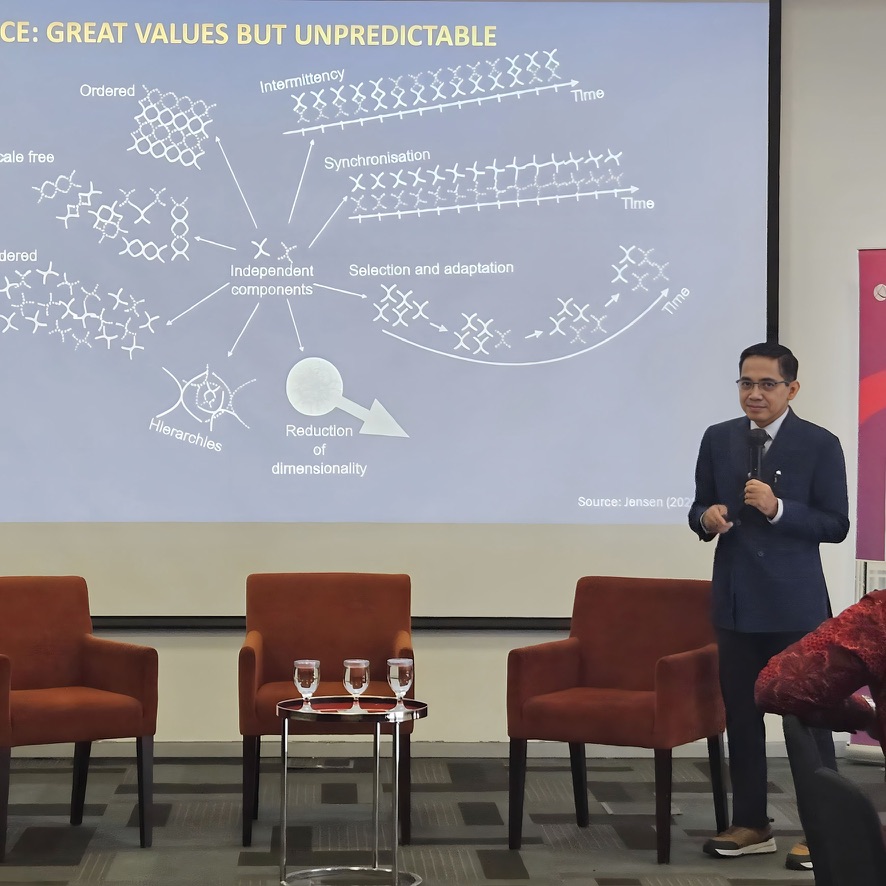
At CIMA’s invitation, on 12 February 2026, I delivered my presentation a CIMA Strategic Leaders Breakfast Talk at the Cyber 2 Building entitled “Leadership in the Age of Disruption — Strategic Leadership for Modern Finance Professionals”. The initial plan was for me to be the sole speaker; however, Mr M Fahmi El Mubarak, CEO of the BUMN School of Excellence, was later added to the programme. It was a real honour for me to share the stage with him.

As discussed at the briefing with CIMA, I explored disruption from the perspective of complexity. The discussion began with a deconstruction of neoclassical economic models, opening up insights into complexity economics. Business as a whole was reviewed as a Complex Adaptive System (CAS), i.e. a system comprising autonomous agents that interact and adapt without rigid, centralised control. The ecosystem is viewed as a dynamic interaction that generates new values non-linearly through the process of emergence.

From the perspective of complexity economics, disruption is not a nuisance but rather an engine of evolution, marking a qualitative shift in economic regimes. Strategy has moved from mere optimisation of old models towards a redesign of business architecture that prioritises learning speed and co-evolution with the ecosystem. Competitive advantage is no longer determined by scale or static efficiency, but by architectural flexibility in responding to internal and external feedback constantly.

Disruption also represents the optimal point for innovation to occur. We refer to this as the Edge of Chaos, which is the transition zone between order (stagnation) and disorder (chaos). In this zone, the system possesses the precise balance required to trigger innovation without descending into anarchy. Excessive order leads only to organisational stagnation, while total chaos results in systemic failure. The duty of leadership is to keep the organisation at this threshold to ensure sustainability through adaptive experimentation.

In an ecosystem model, the role of leadership is that of an ecologist. Leaders no longer micromanage outputs; instead, they are tasked with fostering a culture and environment that enables teams to self-organise. This approach utilises simple rules to guide autonomous decision-making, replacing rigid SOPs that are often too brittle to face ambiguity. Leaders must be courageous enough to engage in safe-to-fail probing: launching multiple small experiments simultaneously to detect strategic opportunities that traditional analytical models might overlook.

Returning to CIMA’s focus on Management Accounting (MA), MA plays a crucial role in governing strategic planning in this exponential era through the SPX framework from the IEEE. MA must be capable of performing Strategic Cost Management to monitor future horizons, utilising Real Options Analysis to value investments as strategic options, and implementing Agile Capital Budgeting. By moving away from rigid annual budgets towards Rolling Forecasts and Throughput Accounting, MA ensures that resource allocation is based on real-time feedback and the velocity of value conversion.

In closing, it was conveyed that disruption must be managed as a catalyst for achieving sustainability and a better quality of life. We must stop viewing business as a machine to be controlled mechanistically and start managing it as a living ecosystem with the capacity to renew itself continually. Furthermore, the finest innovations are those capable of creating new markets and providing a tangible impact on strengthening the economy of society.

IEEE R10 WiE&Industry Forum

The leading role of the IEEE in advancing global science and technology development is undeniable. Still, outside the circles of scientists and engineers, people are more or less blind about the IEEE activities. Interestingly, since the leadership of Prof. Gamantyo Hendrantoro and Dr. Agnes Irwanti in the IEEE Indonesia Section, the publication of IEEE’s scientific discourse has been more widely disseminated to the general public. For two consecutive years, IEEE Indonesia has brought the IEEE President to Indonesia, featuring discussions broadcasted on television to improve the interest of the Indonesian public.

The IEEE President of 2024, Dr Tom Coughlin, paid a visit to Jakarta this week, accompanied by IEEE R10 Director Prof. Lance Fung, IEEE R10 Director-Elect Prof. Takako Hashimoto, IEEE R10 Women-in-Engineering Committee Chair Dr Agnes Irwanti, IEEE Malaysia Section Chair Dr Bernard Lim, and IEEE Indonesia Section Chair Prof. Gamantyo Hendrantoro. As part of the leadership activities, an IEEE briefing was held on the morning of May 14, followed by a talkshow broadcasted by TVRI.

The theme of the talkshow was “Shaping the Future: Women’s Role in Industry” — featuring prominent leaders from the industry, university, government, and the IEEE organisation in the region. One of them is a dear old friend of mine, Elysabeth Damayanti, the OVP of Cybersecurity at Telkom Indonesia. The talkshow started with an opening speech by Dr Agnes, and some keynote speeches from Ms Mira Tayyiba as the General Secretary of the MCI, and Dr Laksana Tri Handoko as the Head of BRIN — the Indonesian governmental centre for research.

As one of the speaker of the talkshow, I started by mentioning the implications of Complexity Science: that we always recognise the diversity of the systems we are working on, where different fields, agents, participants, are all interconnected, resulting in emergence: new values, greater values, surprising values. It is how the Internet and our digital world proliferates, and how both natural ecosystems and business ecosystems sustain. This perspective naturally supports the idea of inclusivity, as different agents from various demographic groups are considered crucial for the survivability and innovativeness of all the systems we are living in, including, surely and crucially, the role of women. It is a key reason to reduce and close the gender disparity.

The WEF has released the 2023 Global Gender Gap Report, mentioning Indonesia in rank 87th out of 146 countries in gender gap. Low enough, but still ahead of some developed countries in Asia, including Japan, China, and South Korea. Indonesian score was about 68% of the gender gap closed — including the relatively low gap in health quality, medium gap in economic participation, and high gap in political empowerment.

We believe that digital transformation that we are developing now, could and should plunge down the disparity. Currently we carry out the digital transformation in strategic & business level to alleviate the economy of the people from the eastern part to the western part of Indonesia; by developing platform, making some piloting implementation with the government, national industry, and then expand it. We work to to enhance MSME business, agriculture, industry, educations, etc, even to remote islands in Indonesia. It is evident, that digital platforms have provided women and men quite equally with wider access to knowledge, services, market & business opportunities. But the transformation must be carefully-planned and deployed with proper education.

Digitalisation in work processes allow us to provide better empowerment for women. It may bypass many social challenges, encouraging women to reduce the unfortunate judgement that are still existing from the traditional norms. Business transformation allow better inclusions in workplaces and business in general. It is also an opportunity for women to aggregate their commitment, capabilities, and opportunities. Use digital services to maximise collaborations, to work in partnership, to be brave take the leadership of the community, to lead the change, and to support each other both in personal level, organisational level, and cross -industry ecosystem.

That is the one of the key. Another key is diversity & uniqueness. So, women should keep their own identity, personality, and mindsets, to preserve different perspectives & values; while opening their mindset to new cultures, different ways of think.

I spent the rest of the time to listen from the honorary speakers of this event. It is one of the most valuable day for me this year, to learn a lot from the wisdoms presented today. Hopefully the IEEE Indonesia Section will continue this valuable activities more and more in the future.

IEEE Presidential Roundtable on Climate Change

It is not a regular occasion of any serving IEEE President to visit Indonesia. In our official note, the first serving IEEE President to visit Indonesia was Prof Peter Staecker in 2013 — he visited Bali for an IEEE Educational Program awareness while I was only days starting my service as the IEEE Indonesia Section Chair. This year, Prof Saiful Rahman, the current IEEE President, is visiting Indonesia for a couple days. The visit is related to the IEEE campaigns in climate change; so it is also the theme of his visit. He is visiting Indonesia accompanied by the current IEEE Indonesia Section Chair, Prof Gamantyo, and the IEEE Malaysia Chair-Elect, Bernard Lim.

As one of the programs within his visit, the IEEE Indonesia Section co-organise with TVRI, an on-air discussion titled the IEEE ASEAN Roundtable on Climate Change. The event was carried out today in TVRI, with the IEEE President Prof Saifur Rahman as the main speaker, and teens of other speakers from the industry, universities, research centres, and government agencies as participants in round table discussion form — including yours truly, representing the IEEE Indonesia Section Advisory Committee, and the IEEE TEMS Regional Leadership Subcommittee. The organiser is TVRI, led by Dr Agnes Irwanti, a member of its Supervisory Board; and Mr Iman Brotoseno, the CEO.

I explored the opportunity of using currently available or currently developed technology to reduce and overcome the impact of the climate change. Climate change is always one of the motivations behind many collaborative innovations in the development of technology and technology-based business.

Since I work in telecommunications industry, I started by giving an example in mobile industry. The use of cognitive radio and dynamic spectrum access (CR/DSA) may optimise green technology by improving the efficiency and utilisation the spectrum by dynamic adaptation to changing network conditions and environmental factors. In urban areas with high network congestion, CR can switch to less crowded frequency bands, reducing power consumption and improving network performance; and it could also optimised to choose the most green-powered network infrastructure available. CR device can lower its power when communicating over shorter distances, conserving energy. CR also enables dynamic spectrum sharing among different technologies. For example, a cognitive radio network can share spectrum with existing cellular networks during peak traffic hours and switch to alternative bands during off-peak times. This optimises resource usage and reduces energy consumption in both networks. With the use of blockchain, spectrum may be shared among operators with easier accounting and cost-sharing.

In more applicative approach in the industry, the paradigm of of ecosystem-based business growth has motivated enterprises to share capabilities, resources, opportunities, so they can reduce the cost and risk, while also reduce the cost for the environment by many sharing methods used in business ecosystems, facilitated by massive digitalisation that enables process and capabilities to be modularised, reused, integrated, improved, and orchestrated among collaborative or event competitive businesses.

The use of technology like the AI and robotics play important roles in addressing climate change in various ways. Some examples:

  • The technology might be used for autonomous sensor-equipped robots, drones, and satellites to monitor and collect data on climate-related parameters such as temperature, humidity, carbon emissions, deforestation, and more. These technologies help in obtaining real-time and accurate data for climate analysis.
  • AI facilitates the analysis of huge amounts of climate data, helping researchers build more accurate climate models. These models are crucial for understanding climate change, its causes, and predicting future climate trends.
  • AI to optimise energy consumption in various sectors, including transportation, manufacturing, and buildings. Smart grids and energy management systems use AI to balance energy supply and demand, reduce wastage, and integrate renewable energy sources effectively.
  • AI-based integrated logistics management (4PL / 5PL) may orchestrate logistics services to share the logistics resources they have, with better supply chain model, supported by better demand and production prediction. It will also reduce the use of fuel and environmental cost to expand the transportation facilities.
  • AI to support agricultural practices, reducing greenhouse gas emissions and improving crop yields. Additionally, robots can assist in precision agriculture, reducing chemical usage and improving sustainability.

There are many more aspect of technology to be used to improve the environmental conditions, including the power management, traffic management, personalised education, etc. Other speakers also explored what we can do in the aspects of education, government policy, and others.

Even after the formal discussion, we still continue the discussion during the lunch session, after Friday-prayer session. I think it is also my first experience to accompany an IEEE President to a mosque to attend a Friday prayer session.

We closed the day with a more relaxing discussion during dinner at Plaza Senayan.

MSME Ecosystem

Since 2016 I have a new role in Telkom Indonesia as the AVP (now Project Leader) of the Industry Synergy. The role of Synergy Department is simply developing the capabilities (mainly digital capabilities) and expanding opportunities of Telkom Group by maximising the collaboration with the industry. As a government policy at that time, the collaborations are prioritised with the state-owned companies (BUMN) in Indonesia. More than three years have passed then. We have changed the Ministry of BUMN, Telkom’s CEO, Telkom’s BOD in charge of Synergy programs, SVP and VP of Synergy, etc. But we are still developing our paradigm of digital synergy, i.e. developing digitally supported economic ecosystems in different sectors.

Using a metaphor from the environment, an innovation ecosystems consists of interdependent parties with different or often competing objectives and concerns, living and growing together in a common digital space, unified using one platform or more to enable them to live better and grow faster. Co-creation, collaboration, and competition are some key activities of the innovation ecosystems.

Last year, the new Minister of BUMN has addressed Telkom Indonesia to develop five ecosystems: Tourism, Agriculture, Logistics, Education, and Healthcare. We even hired a prominent global consultant to help us design the ecosystem. But this February, I requested an approval from the uplinks to add another ecosystem: the MSME ecosystem, to support non-digital micro, small, and medium business enterprises in digital way.

Previously we have had a program called RKB to develop the capability of SMEs in Indonesia. RKBs (BUMN’s creative house) have been established in 245 of 514 cities and regencies in Indonesia. In RKB, BUMNs provide training, consulting, and other facilities to leverage the capabilities of the SMEs in three product categories: culinary, craft, and fashion. But RKBs have failed to attract the SMEs since they do not really improve the sales of the SME products. An MSME ecosystem, on the contrary, should start with MSME commercialisation in mind.

We started with a small design by utilising a multichannel marketing application called SAKOO as our first platform. In March, many cities and locations in Indonesia (and other part of the world) are locked down (until the time I’m writing this post, btw) due to COVID-19 pandemic. We found some contexts for the usecase of the platform. To generate market, we will use BUMNs (and public, using campaigns supported by BUMNs) to create demands for the MSME market. BUMNs may buy the products of the MSMEs for their need, or as an aid to support the communities or health facilities in. Surely we first tried it with Telkom. Telkom has started purchasing MSMEs products using this platform, and has also sent support to communities in Depok.

The Minister of BUMN has a new expert staff: Ms Loto S Ginting — a smart lady working previously as a Director in the Ministry of Finance, managing sovereign bond. Now she advises the Minister of BUMN in the issues of Finance and MSME development. Our BUMN Law (UU 19/2003) mentions indeed that the strategic roles of the BUMNs include providing services for public, counterweight for private business, and support to develop small business and co-operatives. We approached her to discuss this first stage of MSME Ecosystem development program. She enthusiastically accepted the program. In addition, she improve the plan to add B2B transaction facility to the first stage of the program. The transaction data from B2B and B2C are further combined with data taken from e-Procurement systems of the BUMNs to make a dashboard to ensure the increase absorption of MSMEs products and services by the BUMNs. She calls this program PADI UMKM, stands for Pasar Digital UMKM / MSME Digital Market.

Meanwhile, the Covid-19 pandemic has brought the nation into an economic crisis. To survive, MSMEs and their employees need the public involvement. The Minister addressed to rush the MSME platform development. We work with our startup partners: Anchanto, Tees, Payfast, etc to enrich PADI UMKM platform with wider multichannel, logistics management, B2B capability, financing facility, etc. We need to finish it next month (June), so we can start the transaction on July. Eight BUMNs have been selected for pilot project. A new PMO has been assigned to finish this project.

It still felt like a miracle that everything was only in ideation last February, and all activities are carried out during lockdown periods, with all meetings held using vicon, and coordination using whatsapp. Let’s hope we can finish it on June, to support more prosperous small business in Indonesia in long term, or at least, for now, just to have them survive these crises..

Bali: APCC 2013

Alhamdulillah, we have finished APCC 2013. Just like TALE 2013 was somehow related to CYBERNETICSCOM 2012; then APCC 2013 was like a continuation of COMNETSAT 2012, when Prof. Byeong Gi Lee suggested the IEEE Comsoc Indonesia Chapter to host the APCC. This suggestion brought us to attend APCC 2012 in Jeju Island, where we won the bid to host the 2013 APCC. It was followed by a series of activities, including event organising and paper management. The IEEE Comsoc Indonesia Chapter appointed Dr. Wiseto Agung, an avid scientist an researcher from Telkom Indonesia, as the General Chair of the conference. Another strategic step taken is to arrange a partnership with ITTelkom (now the University of Telkom) as a co-organiser on both the technical issue and event organising. Originally, the number of submitted papers raised very-very slowly. A bit stressed, indeed. But a few days before the deadline, hundreds of paper came through the EDAS. From all over the world, those most educated human beings still chose to wait until the final second before submitting their papers. We collected a total of 309 papers. The Technical Program Committee was chaired by Dr Arifin Nugroho, with some vice chairs. The most active TPC vice chair was Dr. Rina Puji Astuti. Meanwhile I held the position of Chair at IEEE Indonesia Section, so I must share my resources (time etc) with many other IEEE activities. The Comsoc Chapter Chair  (Satriyo Dharmanto) and the Past Chairs (Muhammad Ary Murti, Arief Hamdani) continued the struggle to succeed APCC 2013. With strict selection process, APCC 2013 passed only 163 papers (53 % of total incoming paper).

APCC

APCC, Asia – Pacific Conference on Communications, is a very prestigious regional conference in Asia Pacific, which is the region with the highest growth in the world of ICT technology. APCC is supported by the IEEE Communications Society, the KICS in Korea, the IEICE Communications Society in Japan, and the CIC in China. The names of the APCC Steering Committee members are also thrilling: the great figures who pioneered the world of ICT. APCC was first held in 1993 in Taejon, Korea. This year, the 19th APCC was held at the Bali Dynasty Resort in Kuta Beach, 29 to 31 August 2013. I had been in Bali since August 26 to attend TALE 2013. The other APCC organisers, from the IEEE Comsoc Indonesia Chapter, University of Telkom, and University of Udayana, has started preparing the event on 28 August.

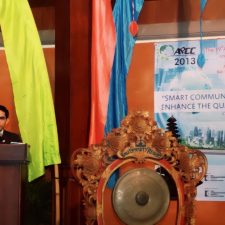
Thursday, 29 August, the APCC 2013 was opened. With a lot of technical sponsors, some representatives had to deliver short speeches at that opening ceremony. But each one took only about 5 minutes. Opening speeches were delivered by Dr. Wiseto Agung (GC APCC 2013), Satriyo Dharmanto (Chair , IEEE Indonesia Comsoc Chapter), Dr. Ali Muayyadi (Telkom University representative), Prof. Zhen Yang (Chair of APCC Steering Committee; Chair of the CIC), Dr. Yoshihiro Ishikawa (Chair, IEICE Communications Society), Prof. You- Ze Cho (Vice Chair , KICS), and yours truly (Chair, IEEE Indonesia Section). IEEE Indonesia Section itself represented the IEEE as the technical activity endorser.

My speech just simply mentioned that Asia Pacific has great significance in the development of ICT. Besides the fact that this area is the center of the most competitive ICT industry, the residents are also among the most adaptive in embracing digital lifestyle in the new culture. Our cultural richness has supported the development of communication technologies, with the ability to understand and support the highly contextual interaction and communications. But the social problems in the region is also alarming. We open access to information technology, but we encourage consumerism. We facilitate the preservation of nature, but we also increase pollution. We help creating new jobs, but we also accelerate urbanisation. The engineers need to design and develop technologies that will address the various issues of humanity and the life of human being. And it was in this social context, that we chose this theme for APCC 2013: Smart Communications to Enhance the Quality of Life .

Keynote speeches were delivered successively by Prof. Byeong Gi Lee (Past President, IEEE Communications Society; Past President, KICS), Prof. Adnan Al-Anbuky (Director of Sensor Network and Smart Environment (SENSE) Research Lab, School of Engineering Auckland University of Technology, Auckland New Zealand), Mr. Indra Utoyo (CISP, Telkom Indonesia; Chairman, MIKTI), and Mr. Ichiro Inoue (Network Systems Planning & Innovation Project, NTT).

The next activities were typical for any international technical conference. Special speech sessions, tutorial sessions, parallel presentation sessions, poster sessions, etc. In the tutorial session, I chose to avoid mainstream discussions of mobile network etc, and chose instead the sensor network as one of the elements for the Internet of Things (IoT). The tutors happened to be a pair of professors from Coventry University. This is a modern university (compared to classical universities) that gained a lot of appreciation and awards everywhere this year. Another regular event was the Gala Dinner, with its semi-formal atmosphere, but also with its permission for a laugh-out-loud sessions. Here the Paper Awards were also presented by the APCC Steering Committee .

The last day, I spent my time to visit the poster sessions. Out of curiosity, I seriously talked to all presenters about the posters presented. It was a way to learn new things while expanding networks. Conversations in the poster session could be deeper and more interesting than the presentation session where time is very limited.

I recognised that it was a hard work for the organisers. In the review session on Saturday afternoon, I said that even though the organisers in any events always feel that there are a lot of unforgivable shortcomings, but the APCC Steering Committee and the participants, had personally conveyed their appreciations and positive feedbacks. Good job! The IEEE, Unitel, Udayana University, and all. Great job! This year there will be many other events of the IEEE Indonesia Section. Hopefully all will provide supports as it was for the  APCC 🙂 . Thanks, all.

Groovia IPTV

The last weekend before my departure to Kyôto, I attended the grand launching of Telkom Group’s IPTV product. We call this new product Groovia. The name was obviously taken after the word groovy. But Telkom also planned to have a kind of product with similar success to Google, Yahoo, Facebook, Joomla, and other 2.o products (i.e. products with two consecutive letters o).

Groovia is not just the implementation of IPTV to distribute television content over the Internet. IPTV is intended as a synergy between the power of the Internet with its web interactions, with the power of broadcast television media. IPTV is regarded as the next step in developing the service platform for multimedia interactions  services.

In the first year, Groovia planned to include the following services:

  • TV on Demand: a service to offer television content with interactivity, and with a recording facility in the network; which allows such control as the video service: pause, rewind, replay, scheduled reports, and others.
  • Video on Demand: non-television multimedia contents that are included in this service, including video films, music, karaoke, etc., with various forms of interaction.
  • Web Service: the interactivity of the cyber world that is integrated into the television system. The services consist among others the social networks, news, weather, stocks info, and others.

The next year, more services such as e-advertising, e-transaction and e-shopping are expected to be integrated into Groovia. In infrastructure layer, the integration of IPTV, SDP, and other platforms, such as store content & applications, is expected to be carried out smoothly, establishing an efficient and comfortable multimedia interaction ecosystem.

But the users will ask: ain’t it costly? The customers of Telkom Speedy with data rate 1, 2, or 3 Mb/s will need only to pay about US$ 5 more to its Speedy monthly subscription to have the Groovia service. Not too expensive for the status as a taste-maker :). Richer contents could be selected according to individual needs of every user. Unfortunately, Groovia is still in the initial deployment phase, and is available only in certain areas in Jakarta. Deployment to other Indonesia cities will begin later this year.

For more information, please visit:  Groovia.TV

SDP Asia Summit

After long weeks of preparing the Indigo Awards, I flew to Singapore to attend The Annual SDP Asia Summit. The invitation was given by Andy Zain and Andreas Surya of Indonesia Mobile-Monday (id-Momo). I have a couple times talked about SDP with them; and also presented it once in FRESH forum. SDP (service delivery platform) itself is a framework to virtualise network & orchestrate services to make it easier to develop, deploy, sale, get, & use digital services. Unlike IMS, so far there is no standard of SDP. This fact somewhat makes SDP discussion interesting: it is about best practice in infocom business.

SDP-Architecture

Since SDP has no standard, companies could easily make a concept of SDP 2.0 (ala Accenture or Telecom Italia) or even SDP 3.0 (HP version). Also there were some alternatives to map SDP to other infocom management concept, such as SOA, SDF, IMS, and even Web 2.0.

When describing the architecture of SDP 2.0, Telecom Italia explores the necessities for service & network abstraction & virtualisation, including reusability and interface standardisation. Scalability & modularity would include plugins capability. Sounds a bit like Accenture version (I have blogged this version in my Indonesian blog), where the objective of SDP 2.0 is to facilitate a self-service for service developer & provider in commercializing their services & contents.

But then Hewlett-Packard introduces this term: service governance framework. It encourages the use of open standard, reusability, and other issues to ensure an effective SDP implementation. Other issue delivered is the utilisation of data mining toward users profile, applications, etc, etc, to make it SDP 3.0.

In the similar spirit, Telemanagement Forum discusses the linkage to business: SOA, SDP, Web2.0, etc, mainly SDF. Great pictures, indeed. They somewhat remind me to C++ standard template library. Discussions with operators, providers, & consultant who are in progress of implementing SDP in Asia & Europe make the days richer.

I guess then I need to make a presentation to summarize them all, and present it to my colleagues this week. Hmm, maybe after the IEEE 4G session(s).

© 2026 Kuncoro

Theme by Anders NorénUp ↑