Tag: Strategic Management

CIMA Strategic Leaders Talk

Within the global finance profession, CIMA (Chartered Institute of Management Accountants) has the responsibility for setting management accounting competency standards oriented towards business strategy. In alliance with the AICPA, CIMA facilitates the CGMA (Chartered Global Management Accountant) professional designation, ensuring that practitioners possess a universal business language for managing organisational performance. The Country Manager for CIMA in Indonesia is Mr Dwi Putra, a Coventry University alumnus who first identified me as a member of the ‘Order of the Phoenix’ because my iPhone lock screen displayed the classic Coventry University logo.

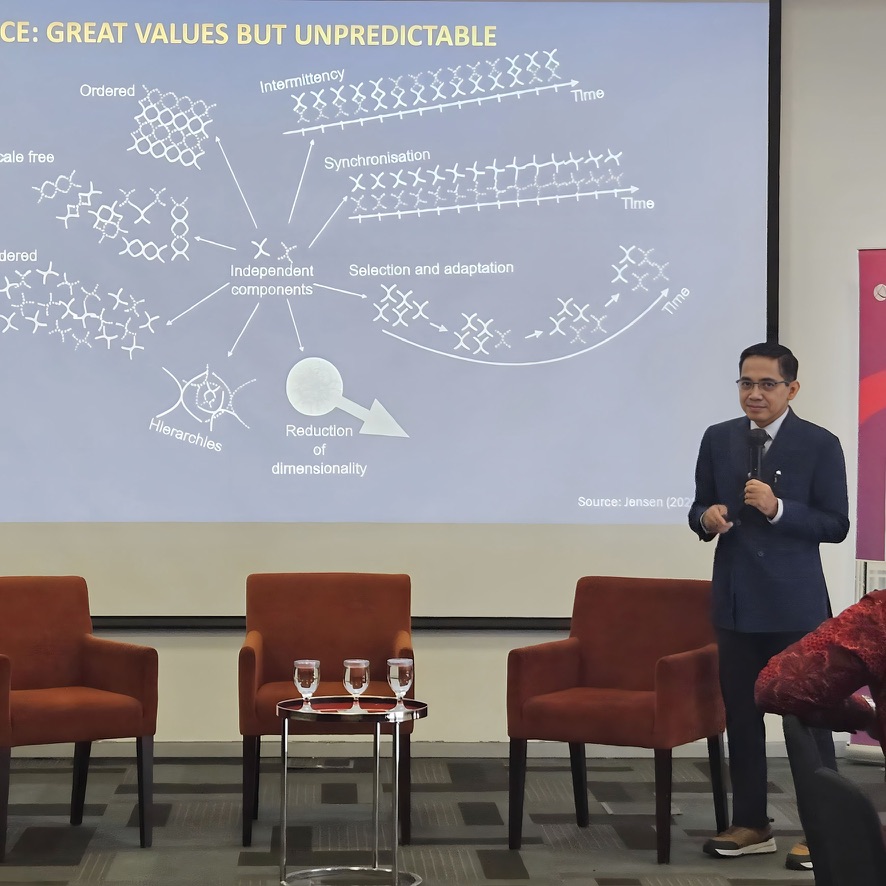
At CIMA’s invitation, on 12 February 2026, I delivered my presentation a CIMA Strategic Leaders Breakfast Talk at the Cyber 2 Building entitled “Leadership in the Age of Disruption — Strategic Leadership for Modern Finance Professionals”. The initial plan was for me to be the sole speaker; however, Mr M Fahmi El Mubarak, CEO of the BUMN School of Excellence, was later added to the programme. It was a real honour for me to share the stage with him.

As discussed at the briefing with CIMA, I explored disruption from the perspective of complexity. The discussion began with a deconstruction of neoclassical economic models, opening up insights into complexity economics. Business as a whole was reviewed as a Complex Adaptive System (CAS), i.e. a system comprising autonomous agents that interact and adapt without rigid, centralised control. The ecosystem is viewed as a dynamic interaction that generates new values non-linearly through the process of emergence.

From the perspective of complexity economics, disruption is not a nuisance but rather an engine of evolution, marking a qualitative shift in economic regimes. Strategy has moved from mere optimisation of old models towards a redesign of business architecture that prioritises learning speed and co-evolution with the ecosystem. Competitive advantage is no longer determined by scale or static efficiency, but by architectural flexibility in responding to internal and external feedback constantly.

Disruption also represents the optimal point for innovation to occur. We refer to this as the Edge of Chaos, which is the transition zone between order (stagnation) and disorder (chaos). In this zone, the system possesses the precise balance required to trigger innovation without descending into anarchy. Excessive order leads only to organisational stagnation, while total chaos results in systemic failure. The duty of leadership is to keep the organisation at this threshold to ensure sustainability through adaptive experimentation.

In an ecosystem model, the role of leadership is that of an ecologist. Leaders no longer micromanage outputs; instead, they are tasked with fostering a culture and environment that enables teams to self-organise. This approach utilises simple rules to guide autonomous decision-making, replacing rigid SOPs that are often too brittle to face ambiguity. Leaders must be courageous enough to engage in safe-to-fail probing: launching multiple small experiments simultaneously to detect strategic opportunities that traditional analytical models might overlook.

Returning to CIMA’s focus on Management Accounting (MA), MA plays a crucial role in governing strategic planning in this exponential era through the SPX framework from the IEEE. MA must be capable of performing Strategic Cost Management to monitor future horizons, utilising Real Options Analysis to value investments as strategic options, and implementing Agile Capital Budgeting. By moving away from rigid annual budgets towards Rolling Forecasts and Throughput Accounting, MA ensures that resource allocation is based on real-time feedback and the velocity of value conversion.

In closing, it was conveyed that disruption must be managed as a catalyst for achieving sustainability and a better quality of life. We must stop viewing business as a machine to be controlled mechanistically and start managing it as a living ecosystem with the capacity to renew itself continually. Furthermore, the finest innovations are those capable of creating new markets and providing a tangible impact on strengthening the economy of society.

IEEE TEMSCON 2024

The IEEE TEMS (Technology and Engineering Management Society) is an IEEE society focusing in engineering and technology management. TEMS serves professionals who work at the intersection of technical and managerial roles, providing resources for innovation, leadership, and strategic thinking in technology-focused business. The society’s mission is to enhance knowledge and skills in managing the processes, resources, and challenges of technology-intensive and engineering-centric projects.

For the 1st time, IEEE TEMS carried out one of its flagship conference in Indonesia. The IEEE TEMS Conference Asia-Pacific (TEMSCON ASPAC) took place in Bali from 25 to 26 September, at the Prama Sanur Beach Hotel. The conference theme, “Achieving Competitiveness in the Age of AI,” focused on the transformative role of AI in modern business and engineering management. The top leaders of the IEEE TEMS, accompanied by scholars, industry leaders, and researchers from around world (beyond only Asia-Pacific region) gathered to discuss topics including updated innovations related to competitiveness, sustainable supply chain management, cybersecurity policies, digital healthcare innovations, and entrepreneurship, etc within the digital ecosystem.

Photo session at the TEMSCON opening ceremony

The conference began with a welcome from Conference Chair Prof. Andy Chen (former IEEE TEMS President and current President-Elect of the IEEE Systems Council). The opening session featured introductory remarks from prominent figures, including Prof. Andrea Balz (current President of IEEE TEMS), and Prof. Imam Baihaqi (Vice Rector of ITS Surabaya).

With Prof Benny Tjahjono and the Coventry University Gang at the TEMSCON opening ceremony

The keynote presentations were delivered by distinguished academics: Prof. Richard Dashwood (Vice-Provost for Research and Enterprise and Deputy Vice-Chancellor for Research at Coventry University), Prof. Alexander Brem (Professor and Vice Rector at the University of Stuttgart); and Prof. Anna Tyshetskaya (Vice Rector at Sankt Petersburg University in Russia). After the opening, the conference continued with breaking sessions for research paper presentations.

The second day of the conference was carried out as an Industry Forum with experts highlighted the challenges and opportunities that AI brings to global competitiveness. The speakers, besides Dr Ravikiran Annaswamy (the Past President of the IEEE TEMS) and Dr Sudeendra Koushik (the President-Elect of the IEEE TEMS), was yours truly. It was surely an honour. The title of my presentation was “Towards Complexity-Based Strategic Management.”

Keynote Speech by Yours Truly at TEMSCON Industry Forum

Following the lunch break, the forum resumed with an engaging panel session on “Accelerating Innovation for a Sustainable Future.” Prof. Marc Schlichtner, (Principal Key Expert at Siemens) served as the speaker, with Prof. Robert Bierwolf (TEMS Board of Governors Member) moderating. The panelists included esteemed leaders in technology and engineering management: Prof. Alexander Brem (Professor and Vice Rector at the University of Stuttgart), Prof. Anna Tyshetskaya (Vice Rector at Sankt Petersburg University in Russia), and yours truly. Truly an honour to share the stage with such distinguished figures.


The conference concluded with a gala dinner that offered a warm and lively networking opportunity for all participants. This included the TEMS Executive Committee, Board of Governors members, and leaders from various universities, fostering valuable connections and camaraderie across the academic and professional communities in attendance.

© 2026 Kuncoro

Theme by Anders NorénUp ↑